Saturday, 18 April 2015

A Zeppelin Over Yarwell

I have not put out a post recently because I have been very busy writing the book , which will be  titled A Zeppelin Over Yarwell, The War Story of Six Villages.

The research for this book has revealed lots of stories about the soldiers and of the villagers.

Charlie Bream, from Nassington was born in 1883. He was the eldest son of a railway platelayer in Nassington. In 1903 Charles joined the 1st battalion The Northamptonshire (D Company) Regiment and saw active service on the Indian Frontier in 1904, for which he received two medals and two bars. On leaving the Army he became a Police Constable in Durham. He was called up at the start of the War and on departing from the police force he stated that 'if I should be spared sir to come back it will be with clean hands and a clear conscience'.

He applied for the Grenadier Guards but because of 'still joints' was rejected so he  re-enlisted into the 1st Battalion The Northamptonshire Regiment. On August 17th 1914 his regiment left for France and he was with them when they were forced to retreat from Mons. In a letter to a friend he wrote
'you will have heard about the battle on the Aisne we were in the trenches for a month, and the first week it never ceased raining and we had to stick it.
On another occasion he wrote saying, 'that we were in the trenches for a month and it rained day and night for a week. We were wet through to the skin even to the bone. My hand was wounded but it was nothing to shout about. The doctors were  too busy to dress it so I got an R.A.M.C (Royal Army Medical Corps) man to dress it. I went back to the firing line on the same day. I thought that I had been done in; I did not care what became of me. The Germans were at us for three solid weeks. Thank God it has eased off a bit.

Later, when at Festubert, Charles wrote  'that they had had several engagements with the Prussia Guard, but got through them doing six bayonet charges in ten days'.

Charles was killed shortly after this last letter was posted in yet another bayonet charge at Festubert on December 21st 1914.
Charles is remembered at Le Touret Military Cemetery.

Thursday, 27 November 2014

A Zeppelin Over Yarwell

The Tithe Barn Museum with its exhibition, A Zeppelin Over Yarwell, is now closed for the winter. 

The exhibition will open again for one more year next spring (2015).


In the meantime we are busy writing a book about the villages and  the impact  that  WWI had on the families of the six villages that were included in our research. Its a big project as we hope  also be able to provide some statics,

  • such as how many men signed in the first rush of 1914. 
  • how many were conscripted, 
  • what was the average age our our soldiers.
  • We are also looking at the vary varied regiments.
  •  Initially we had supposed that they would have mostly enrolled into the Northamptonshire Regiment, which currently does not seem to be the case.
  • and we looking at their pr-war employment.


  • Charles Bream who was killed in action on  December 21st  1914.

Tuesday, 23 September 2014

A Zeppelin over Yarwell.


Joseph Thomas Scotney was married to Susannah and they had two daughters.
Prior to the war he was a farmer and butcher, who used to deliver his meat around the villages. 
He was elected treasure of the coal club in 1914. 
Joseph was probably conscripted in 1916 and enlisted into the  Northamptonshire Regiment as a signaller on November 31st 1916.

He seems to have had disciplinary issues. In April 1918 he was absent from fatigue. On another occasion he forfeited 4 days pay and was later ordered to pay for a new pair of trousers for, ‘loosing through neglect’, and for ’5 rounds of ammunition three days pay’. 
On March 3rd 1918 he is recorded as missing but was later listed as a Prisoner of War on 25 March 1919. 
The photo show s him delivering meat before the war.


Thursday, 4 September 2014

A Zeppelin over Yarwell

I have just up loaded our WWI web site A Zeppelin over Yarwell . It has been designed by Mike Brown one of the members of our group. click on the link below.

I  have a broken wrist and when I am out of plaster I will post more.


http://azeppelinoveryarwell.weebly.com/

Saturday, 16 August 2014

A Zeppelin Over Yarwell

Receiving our award  in  July at Sywell Aviation Museum.


 Apart from putting all our research into a book we also have to finish the website, which is the job for Mike.
Mike is on the right of this photo.

A Zeppelin Over Yarwell

We have mostly finished working on the exhibition and were very pleased to have been award the top Heritage Community Award in July for the project.  However people are still bringing in information to us, all of which will be included in the book which we will be publishing in due course.

This lovely little box was posted out to Charles Simmons who served in the Northamptonshire Regiment. He was injured by shrapnel in France in 1916. He was transferred into the Army Labour Corps in 1917 and was discharged on April 8th 1919.

The photo below is of horses in  Yarwell which was reputedly posted to Charles while he was still in the army.

Saturday, 19 July 2014

A Zeppelin Over Yarwell

The exhibition was formally opened by Air Vice-Marshall Wawrick Pike Retd. to which there was an incredible turn out by people from the six villages and  those from  further afield.

.

Saturday, 24 May 2014

A Zeppelin Over Yarwell

 Just as we had finished laying out and displaying all the photographs and artefacts I had a phone call from an old man called John Lock who was born in Nassington and went to school in the village. He told me that he had some interesting medals and drawings that were done by his father during  WWI. They are mostly pen and ink humorous  drawings, but of a high standard.

It would seem that John Lock's  father Arnold Victor Lock emigrated to Canada in 1910. At the onset of WWI he enlisted into the army and became a Regimental Sergeant Major in the Canadian Forces.

He was working on railway construction at the front when the sidecar of the motor bike in which he was riding hit a pocket of gas and damaged his eyes. He was eventually discharged and returned to England to live in Nassington.


Currently all the drawings are in plastic folders but I am going to purchase some Miramex ones, so that the drawings do not incur further damage. We will not be displaying the originals but be taking photographs of them for display. I hope to meet John again as he was full of very interesting information about the village.

Tuesday, 13 May 2014

A Zeppelin Over Yarwell

We have put up a lot of stories about building the
Zeppelin but we also worked with Nassington  Primary school on our WWI project.

They have been looking at old school records to find out what happened in the school during WWI.
They found that the punishment book was the most exciting because they learnt which soldiers were naughty at school. They discovered that a punishment could be up to six whacks on the hand with a cane. They were surprised to learn that the Northamptonshire Regiment came to assembly and showed the children a bomb! The children did not think that a bomb would be allowed in school today.


     The children also wrote and designed a leaflet using information that they had          gained from the school log books. We have distributed the leaflets around          the area.              
Some of the children learnt to knit mittens, just as the children did during WWI, when a large number of mittens were sent out to the troops.                                      

Wednesday, 30 April 2014

Zeppelin Over Yarwell

We are nearly there. The Zeppelin is in its final resting place and Mike has put up the sign.


On March 6th 1916  John Coleman Binder  in Oundle was called out for duty at 11.15 pm because zeppelins were in the area. He heard a zeppelin but did not see it. One of the other men also on night duty heard an explosion in the distance.  On the following day Coleman Binder learnt that Zeppelins had sailed over the Eastern counties along the east coast but the Zeppelins got no further west than Wansford.
This might have been the occasion when a bomb was dropped somewhere above Wansford.
On Friday 19th April 1918 Zeppelins raided again this time dropping a bomb which fell into a wheat field opposite the Yarwell/Nassington cemetery. The explosion was so load that it could be heard in Oundle 10 miles away. The bomb crater is still visible in the field.


Thursday, 24 April 2014

A Zeppelin Over Yarwell Continued.

Since we last posted a blog about this project we have been working very hard to compete the exhibition in time for its opening in May. We raised the Zeppelin which looks more like a giant slug.


Here we are putting up the fishing line which will hold the Zeppelin. We had to attach eight lines onto the beams on either side.


Then with the help of adults and children we began to slowly raise it up.
I was quite nerve racking since we  were worried that we might drop the Zep as we now call it.

It is now up and if we open the big barn doors it sways gently in the breeze.

In the meantime our research into the families and the effects the war had on them continued.

Thursday, 23 January 2014

Zeppelin Over Yarwell, continued.

The Zep, as we now call it, has got all its material on, has its tail wings on, and has had its undercoat painting done. Its a bit blue looking, but it is grey and the top coat will be a darker grey. It looks like a great big slug, perhaps we have made a new species. The only area not painted is the underside,which cannot be done until we lift it up a bit. Lifting it is going to be very difficult.


Saturday, 18 January 2014

A Zeppelin Over Yarwell Continued

We have been working on the Zeppelin for many weeks now. It can get very cold since there is no heating in the Tithe Barn Museum, so we pile pullovers on and hope for the best.
This photo is of the Zeppelin when it has had the binding on to which the material will be attached.


Zeppelin with its binding.


The large white disks are made from polystyrene and are joined together with doweling rods. We have chosen polystyrene  because it is light and we want to hang the Zep from a tie beam in the roof of the museum.
Well that is the plan at the moment!


The next job will be to put the material on. We will be  using calico which can be obtained in Peterborough market at a reasonable price. As the Zeppelin is 14 feet long, it takes a lot of everything.

The Zeppelin with its  calico covering.


Here Mike is holding it while I take the photograph. It has been quite difficult to get the material taut, and where it is not we will be using shrinking dope.


At least it did not fall apart when we lifted it up!


Today my grandsons and I lifted the Zep, as we now call it, onto a long table. All the calico is now glued on and the next job will be to attached the wings at the back and finish of the nose. it will then be painted grey. Currently it looks like a giant slug!

Friday, 6 December 2013

Zeppelin over Yarwell. Mannequins


Today we began to assemble our mannequins.
Body parts were strewn all over the floor and it looked as if there had been a massacre, but without any blood.


The bodies assembled quite easily but the man's feet would not touch the ground and he is far too wobbly to be stood in the Tithe Barn Museum; he would certainly fall onto somebody.

The lady was more seriously afflicted; she has two right arms!

Ringing the supplier for the man was not very useful as he girl who answered the phone did not know why the man was not standing correctly. As yet we await an email from the the company that supplied the lady.
We have some clothing and the rest is mostly ordered. We hope to have photos of the fully dressed mannequins in he New Year.


Wednesday, 20 November 2013

Zeppelin over Yarwell. The Zeppelin.

We have started to make the Zeppelin for our new exhibition for 2014, ‘ A Zeppelin over Yarwell’.


The frame is to be constructed from polystyrene sheets and bamboo. We shall stretch thin cotton over the frame and glue it in place, it will then be painted.  The completed zeppelin will be 1.2 m at the widest point and about 3.5 m long. Our biggest problem is likely to be hanging it high up in the Tithe Barn.
We cut out the polystyrene in the kitchen because it was far too cold to work  in the Tithe Barn.
We made a hell of a mess and even after hoovering we are still finding pieces of foam on the floor.


Monday, 11 November 2013

A Zeppelin Over Yarwell

A Zeppelin Over Yarwell


With our grants all in place, £3400 from the National Heritage Fund and with £500 from the
Northamptonshire County Council Empowering Councillors & Community Scheme, we are full steam head.
We have spent a lot of time researching the war dead and injured from our local communities, and we have also been looking at the families of these soldiers. Luckily  Lance Lock who lived in Nassington as a young boy and then in the neighboring village of Yarwell, wrote a history of the villages, called When I Was A Boy. He was born in 1910 and educated in the Nassington Primary school.
 It is full of information about the first world war families, which is proving to be very useful. Lance knew every one, and as an adult he had a lovely farm in Yarwell. All his barns on Manor Farm ,Yarwell have now been converted into houses and the farm has completely lost its identity.

We will be having two mannequins in our exhibition, one dressed as a WWI soldier and the other as  a land army girl.

 Oundle Public School has lent us a WWI uniform, which is a great help because they are very expensive to buy.  All we now have to obtain is a shirt, socks and shoes.                                              


Thursday, 17 October 2013

A Zeppelin Over Yarwell

We are very pleased to be able to announce that our project will be funded by a grant of £3,400 from the Heritage Lottery Fund, which will enable us to continue with this project.
The exhibition will be called A Zeppelin Over Yarwell, an allusion to the sudden WWI wartime appearance of a  Zeppelin over the village (to the considerable consternation of the villagers) which dropped a bomb in the nearby village of Wansford.

We plan to build a Zeppelin, not a full size one, to hang in the rafters above the exhibition. Currently we are trying to work out how to build one!
 We will not be using cow guts as reported in the Times Newspaper!
 
Our village school will also be involved with this project, knitting mittens,
 as the children did for 'the troops at the front.'


Tuesday, 10 September 2013

A Zeppelin Over Yarwell

It has been a long time since we have blogged because we have been busy collecting information from all the villages. We have also applied for a grant from Heritage Lottery Fund (HLF) to enable us to put on the exhibition in the Tithe Barn Museum. We will not know if we have been successful until the end of September.

We have also managed to find some photographs and information about some of  our war dead and injured. For instance George Briggs who came from Nassington was only 19 when he was killed at Flanders.

He came from a family of  nine. His father Fredrick Briggs was a horse keeper and they all lived in a small three roomed house.

This is George's older brother who had been a farm labourer         in Nassington, but is leg was badly injured in action on
the 9th May 1915 aged 18 and he was unable to work for some considerable time after the war.                          

Wednesday, 20 March 2013

The War to End all Wars - A Zeppelin Over Yarwell


With the anniversary of the start of the First World War rapidly approaching, the Prebendal Manor Tithe Barn Museum has joined with other groups to mark the occasion.
We are concentrating on the effect that the war had on Nassington and other local villages.
The war had a great effect on those that returned.


Herbert Mee. 1938

One such person was Herbert Mee, whose family lived in the Prebendal manor.

During the archaeological excavations in the front garden, the remains of a small bonfire were discovered just below the top soil. Two pieces of metal alloy metal were in the ashes. 


Herbert Mee's army shoulder badge and his dog tag
                                                                A shoulder badge of the East Surrey regiment. 

A dog tag is inscribed:

PTE. H MEE. 
7142 
CE 
7B. E. SURREY.

(CE is for his religion, church of England)


It would seem that Herbert returned from the war and burned his memories of it in the garden.
He had been wounded and received shrapnel in his leg.


Wednesday, 31 October 2012

RESCUING THE ARCHAEOLOGICAL ARCHIVE

Extensive archaeological excavations were undertaken in 1984 at the Prebendal Manor and its surrounding grounds. However all the plans and notebooks were taken,  by one of the excavators, to the Czech Republic  on the understanding that a report would be written for publication. Having waited for twenty one years for this to be completed Mike and I decided that it was time for the archive to be returned to the manor, collated and sorted out for publication.

We left very early on a cold wet Sunday morning in late October, groaning at the thought of the very long drive ahead of us.  Our destination was 851 miles away. We wondered if we would really be given the archive, or if this going be a wild goose chase and we would return empty handed.

Here we are waiting to board Le Shuttle at Folkstone.


The tunnel crossing is very efficient  and once we disembarked we were soon on our way. Since I was the driver I was glad that the weather gradually improved.
The European road system is excellent but nevertheless we had carefully marked our route on the map. A route which was to take us across Belgium and Germany and into Czech Republic.

However there was no way that I was going drive  non-stop to our destination, so we chose the Hotel Montana in Limburg, Germany, as our stop off place. The hotel is close to the motorway and was relatively easy to find in the dark.


The hotel did not provide an evening meal on Sundays but luckily there was a really nice restaurant close by.

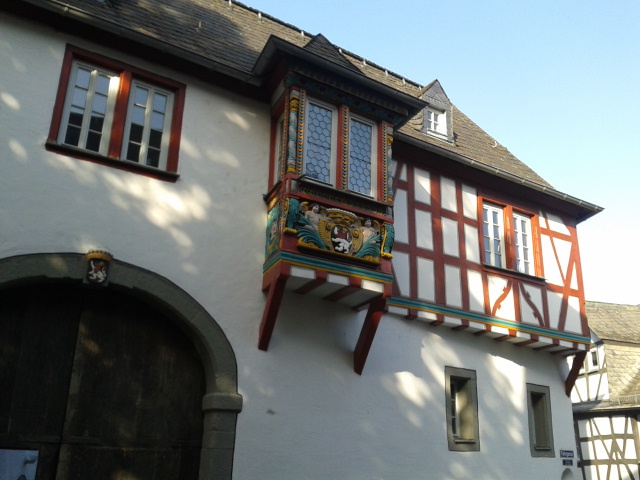
Limburg is a really beautiful medieval town and on the following we decided to spend some time wandering around before we left for the final long lap of the journey.

This was an apothecary shop in the centre of the old town.
There was also  a huge beautiful church on the top of the hill overlooking the town.


Unfortunately my phone had run down, so I was unable to photograph it.


Everywhere we walked there were interesting buildings to look at. We would have like to have stayed for longer, but our mission was to save the archive, so reluctantly we left.


Our arrival in Czech Republic was later than planned because we got lost and the myriad of small country roads, with names of villages that we did not recognize, was confusing. I must have driven around one small village several times before we saw the tiny turn off to our destination.  It was a great relief when we finally arrived very tired and hungry.
                                                                                                                                                                                             
                                                                                              The house was cold and very dirty as it is in the process of being renovated. I had thought that it might not be very nice, but I had not expected to find so much chaos. It does not have a bathroom and only a very basic loo, in what must have once been a small cupboard. Having had supper in a local restaurant we rolled ourselves up into our sleeping bags and wondered where the archive could possibly be kept. There was dust and mess everywhere and this was to  be our destination for three days!


The outside privy in the adjoining garden. We were told that it is only used when the 'old man visits'.

 We dared not mention the archive and had no idea where it was. In the meantime our host took us to see some really interesting places.    

The entrance to the castle
This is the castle in Shihov, a village about forty minutes from where we were staying. We arrived as it was getting dark, but the keeper of the castle gave me the huge bunch of castle keys to open the great front door. Once inside he kindly gave us a guided tour.

The castle keys
  The inside rooms are vast and must have once been very grand, but they were too dark to photograph.


One of the goats that lives in the castle grounds.


On the following morning, with still no mention of the archive, we went on a long drive to see Cesky Krumlov a really wonderful medieval small Czech town which is a World Heritage site. The castle is huge and sits on a very large rock. I have never seen such an amazing place. Beneath the castle is the medieval town, which is full of interesting houses, many of them highly decorated.

One of the painted buildings within the castle.


One of the paintings on the side of a building. Bears were once bred on the castle premise and there is still a large bear pit containing bears. 

The journey to this town took about two hours but it was well worth it. I could easily fill this entire blog with photos of this town it was really an amazing place.


Back to the saving of the archive. Mike and I were becoming quite concerned about it, since nothing had been shown to us.  
As luck would have it I came across it in a room that we had not previously been in.
This archive contains about fifty archaeological plans and all the notebooks of  the archaeology of the Prebendal Manor, a site that has been in use since the Iron Age period.  The archive, although looking pretty grotty here, is crucial to the publication of the archaeology of the Manor. I have been asked  countess times as to when the publication is likely.


We found one more plan elsewhere, and on leaving had to hide it within our sleeping bags before loading up everything into the car.


On our last day our host took us to see one of the local towns which had a wonderful  garden walkway with statues. I have no idea what these figures represent as I could not read the Czech information!


 The decorated  town hall in Plezn


On our final evening our host handed over the archive and we stored it away safely in the car and went out to have dinner in a restaurant, which was once part of a grand house. Here we had the best meal of our stay in Czech Republic.

On the following morning we left early to make our way home. Once more we stopped at the Limburg hotel en-route. Having not had a proper wash the entire time we were in Czech, the first thing we did was to shower and clean up. It felt really great to be clean again!

We had intended to visit Archon, in Germany, on our way back but we took the wrong turning off the autobahn and it took so long to find our way back that we ran out of time.


We stopped for coffee outside Wurtzburg, which is a wine growing area. The grapes had all been harvested but the autumnal colours were very pretty.

                                                                                   One of the grape varieties.


And so home again. Down long tunnels, past colourful forests and useful road signs


After two days of rest we celebrated the retrieval  of archive with a bottle of champagne.

So this is what it is all  about.  We felt that the lack of publishing such an important site after twenty one years was not good. There is a lot of work to bring it up to standard for publication but at least now that it is back in England there is a greater chance.
This is a plan of the manor and demolished solar area showing the Iron Age ditches the Anglo-Saxon phase of about 900 AD and the aisled hall dated to about 1000 AD. The blue colour is where Time Team excavated in 2003.
Drawing by Pat Foster and Gill Johnston and added to by Wessex Archaeology for Channel 4 Time Team.

This is one of many plans that are in the archive, most of them require bringing up to publication standard.